


Syllabus: GS3/Agriculture
Context
- The United Nations Food and Agriculture Organization has declared 2026 the International Year of the Woman Farmer (IYWF 2026).
About
- Workforce shift: Rural men are moving to non-farm jobs leading to women replacing them in agriculture.
- Rise in women’s participation:
- Employment in agriculture surged by 135% in a decade.
- Women now account for 42% of the agricultural workforce.
- 2 in 3 working women are engaged in agriculture.
- This still remains lower than the rest of the world, women’s work participation was in the range 57%-63% in a majority of countries.
- In 2023-24, there were at least 117.6 million women working in agriculture (of whom 21.7 million were hired workers, 95.1 million were self-employed and 0.8 million were regular workers).
- The estimated male workforce in agriculture was 127.5 million.
- Economic Impact: Women’s greater participation has not translated into higher income for the economy, as agriculture’s share of the national GVA fell from 15.3% in 2017-18 to 14.4% in 2024-25.
Challenges Faced by Women in Agriculture
- Unpaid Labour: Nearly half of the women in agriculture are unpaid family workers, with their numbers jumping 2.5 times from 23.6 million to 59.1 million in just eight years.
- In States such as Bihar and Uttar Pradesh, more than 80% of women workers are in agriculture, and over half of them receive no wages.
- Systemic Inequities: Women as farmers, own only 13-14% of land holdings, and earn 20-30% less than men for equivalent work.
- Asset ownership, decision-making power, and access to credit and government support remain male-dominated, trapping women in low-value activities.
- Digital Divide: Barriers in digital literacy, language, affordability of devices limits the participation in modern agri-markets.
- Therefore, the feminisation of agriculture; has, in a way, reinforced inequities rather than enabling women’s economic empowerment.
Emerging Opportunities
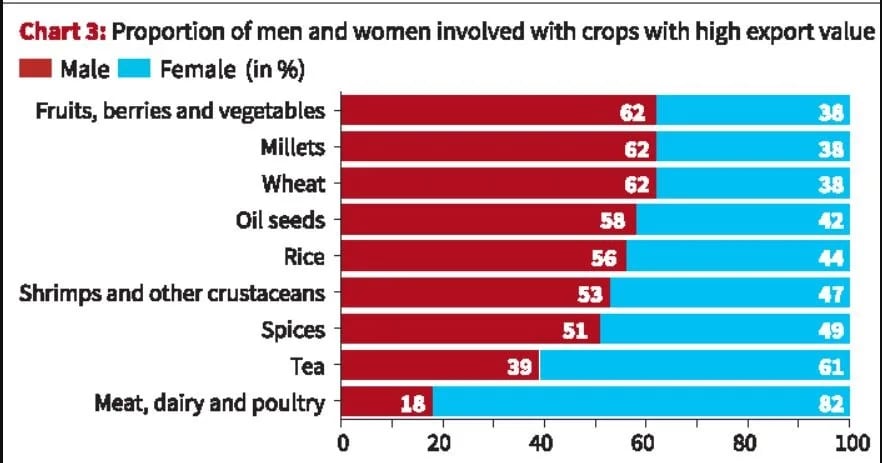
- High-Value Segments: With global demand rising for organic products and superfoods, India’s value chains for tea, spices, millets and certified organic produce are poised for expansion in sectors where women are already strongly represented.
- Geographical Indications, branding initiatives, and support for meeting export standards can help women producers shift from subsistence farming toward premium, value-added product markets.
- Digital Innovations: Digital innovations can play a decisive role in bridging this gap.
- Platforms such as e-NAM, mobile-based advisory services, voice-assisted applications, and precision agriculture tools are already connecting women to markets, knowledge systems, and financial services.
- These solutions help formalise women’s labour while expanding access to schemes, credit, and fair pricing.
Government Initiatives for Women in Agriculture
- Mahila Kisan Sashaktikaran Pariyojana (MKSP): Under National Rural Livelihood Mission (NRLM), supports women farmers in sustainable agriculture, livestock, and NTFP (non-timber forest produce).
- Joint Land Titles: States encouraged to issue land pattas in joint names of husband and wife.
- Priority Sector Lending (PSL): Mandates credit flow to women farmers.
- Rural women SHGs & FPOs: Supported through NABARD and DAY-NRLM.
- Agri-Clinics & Agri-Business Centres (ACABC): Special provisions for women agri-entrepreneurs.
- Digital Literacy: Initiatives like Digital Sakhi, BHASHINI platform for multilingual access to agri-services.
- Maternity Benefits & Health Schemes: Support women farmers’ welfare indirectly.
- Support for Women FPOs: Encouraged under the 10,000 FPOs Scheme (2020) with special provision for women-led groups.
- GI Tags, Branding, and Export Facilitation: Helps women producers in spices, tea, millets, organic produce.
Way Ahead
- Without targeted measures, women risk being excluded from the export-led opportunities emerging in Indian agriculture.
- To transform women’s role in agriculture, land and labour reforms are equally vital.
- Policies must recognise women as independent farmers by promoting joint or individual land ownership, which in turn strengthens their eligibility for credit, insurance, and institutional support.
Source: TH
Previous article
Stranded Renewable Power and Grid Constraints in India
Next article
Why is India staring at LPG Shortage?
